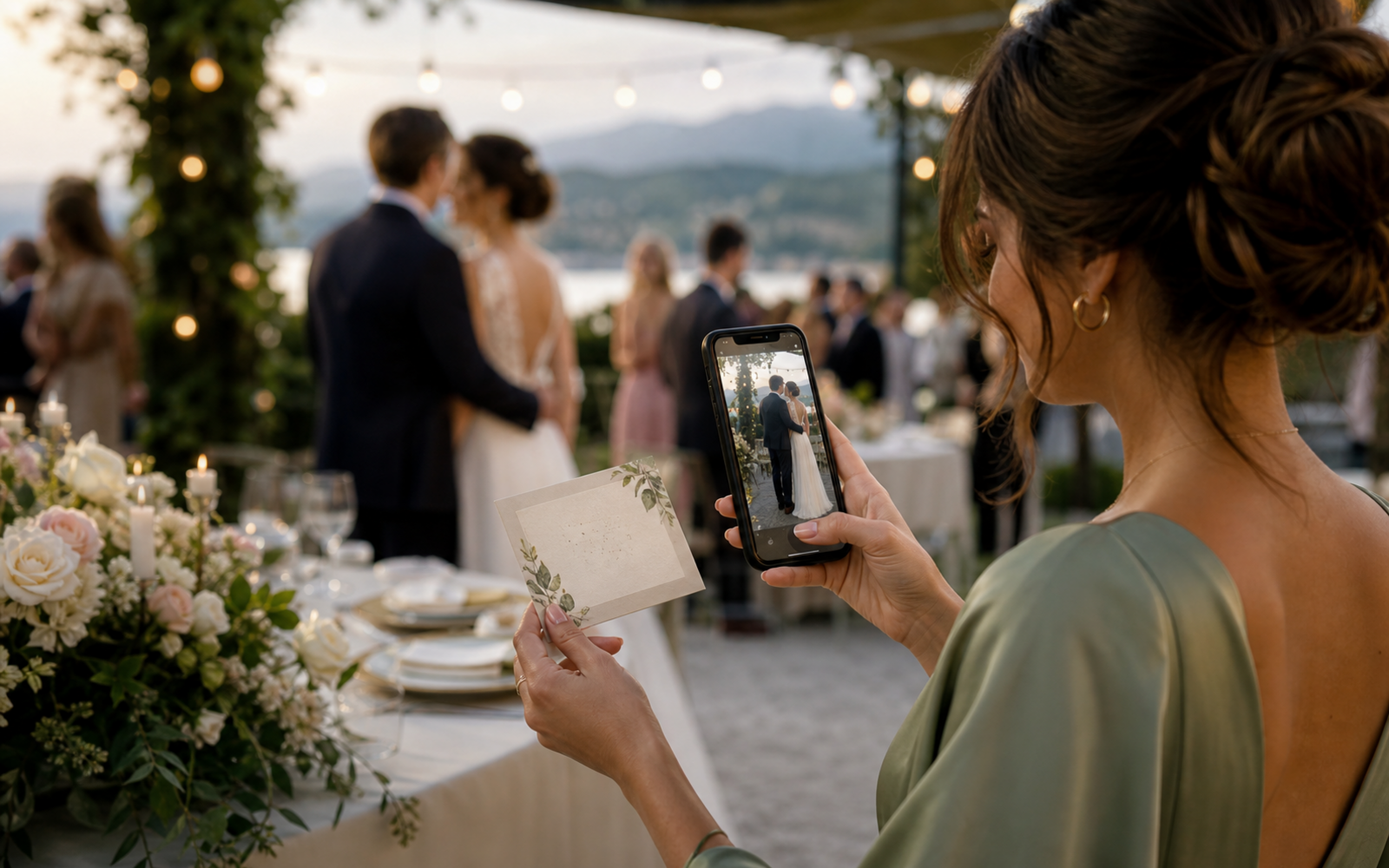
A good wedding guest photo experience should not pull people away from the celebration. It should feel natural, clear, beautiful, and easy to join.
Guests do not need another task. They need a gentle invitation.
Start with the memory you want
Before choosing a platform, card, or QR code, define the purpose. Do you want a random collection of pictures, or do you want personal moments from the people who know you?
A stronger prompt might be: take one photo of a moment you want us to remember.
That small sentence changes the quality of participation.
Make the flow effortless
The best guest photo experiences are simple. No app download. No long sign-up. No hunting for a link.
A clear QR code can help guests participate in seconds, especially when it is placed where people naturally pause: welcome tables, dinner tables, bars, or guest book corners.
Use a creative constraint
A limit can make the experience better. One photo per guest creates a small moment of choice. It tells guests that their perspective matters, but it also asks them to be selective.
That is the difference between send us anything and give us one memory.
Design the physical touchpoints
Your photo experience should belong visually to the wedding.
Consider:
- a small card at each place setting;
- a sign near the guest book;
- a QR code styled with your stationery;
- a short, warm instruction;
- enough contrast so the QR code scans easily.
Where MomentoShake fits
MomentoShake turns this into a simple ritual. Guests scan a QR code, take one meaningful photo, add a message, shake the phone, and watch the image develop into a private Polaroid-style album.
It is not about collecting every possible image. It is about helping each guest choose one that matters.
If you want your guest photo experience to feel intentional rather than improvised, explore the MomentoShake experience.
Practical planning framework
A useful way to apply this in real wedding planning is to decide three things before you choose any tool: the prompt, the limit, and the container.
Start with the prompt: what exactly are guests being asked to notice? Keep it specific and emotional, not generic.
Then decide the limit: one photo per guest is usually enough to improve quality and reduce post-wedding sorting fatigue.
Finally choose the container: a private album with a clear access point usually performs better than scattered channels.
If these three decisions are clear, participation feels effortless and the final archive feels coherent.
Common mistakes to avoid
Couples usually run into the same issues:
- asking guests to upload everything without a prompt;
- collecting photos in multiple places;
- giving technical instructions without emotional context;
- skipping privacy expectations;
- waiting until the last week to set up the flow.
A small amount of intentional setup before the wedding prevents most of the confusion after the wedding.